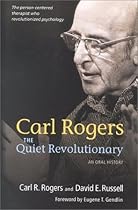
Carl Rogers: The Quiet Revolutionary an Oral History Rogers (1902-1987), a founder of the humanistic psychology movement, is one of the most influential psychologists of the twentieth century.Carl R. His deep belief that each person has worth, dignity, and the capacity for self-direction was counter to the pervading thought of his day. On Becoming a

| Title | : | Carl Rogers: The Quiet Revolutionary an Oral History |
| Author | : | |
| Rating | : | 4.88 (865 Votes) |
| Asin | : | 1883955300 |
| Format Type | : | Hardcover |
| Number of Pages | : | 352 Pages |
| Publish Date | : | 2002-11-01 |
| Genre | : |
Carl R. Rogers (1902-1987), a founder of the humanistic psychology movement, is one of the most influential psychologists of the twentieth century. His impact on education, counseling, psychotherapy, conflict resolution, and peace is unparalleled. He has enriched the world through his empathic presence, his rigorous research, and his authorship of more than two hundred articles and sixteen books. On Becoming a Person is one of the classics in psychological literature. Dr. Rogers created a profound and fundamental shift in the fields of psychology and human relations. His deep belief that each person has worth, dignity, and the capacity for self-direction was counter to the pervading thought of his day. In order to fully understand and appreciate his impact, it is important to know what experiences shaped his life and what influences directed his thinking. Carl Rogers: The Quiet Revolutionary is a unique kind of autobiography, or oral history, that explores all these aspects of his life
Editorial : What a trip! The family farm, China, Japan, New York, Rochester, Ohio, Chicago, Wisconsin, La Jolla, Ireland, South Africa and many stops along the way. But above all, it is the story of Carl's journey as a person, his ideas, his caring. I loved traveling with Caqrl in these pages. --Tom Greening, Editor, Journal of Humanistic Psychology
True to his own maxim that "the most personal is the most universal," this deeply personal story reveals why Carl Rogers' revolutionary psychology has had the power to permeate entire cultures. Through his own eloquent words we experience the ways he gradually made the links between inner psychological needs of individuals and larger social realities such as politics, intergroup conflict and peacemaking. A great read, and for generations of practitioners new to his radical ideas, a clarion call to think bigger thoughts about what humanistic psychology can offer the world in these times. --Maureen O'Hara, Ph.D., President, Saybrook Graduate S

She convinces villages to welcome their children back home. You felt the highs and lows with her as she is on this journey of helping these girls/women. She even hires a cook! The most important thing she provides is love. But she did not stop there. A good survey.. And a group of young girls, most of which have young babies themselves, are soon calling her "ma" as well.
It is important not to miss the subtitle - "A Memoir of Reconciliation". And through her radio program and community outreach, she helps people to understand that revenge is not the answer to Liberia's problems. Shows at least 1,000 examples of shapes and textures that can give anyone ideas to throw at. Katrell's experiences develop from her childhood in the American South, to an adult epiphany in the sometimes-crushing/often-rapturous Indian mountains, where some things have to be seen to be believed. I can’t save the world, and I might not make an earthshaking difference outside of one isolated town,

No comments:
Post a Comment